New
The Trnava Region is going to reconsider its approach to improving air quality after 12 years
11. 12. 2025
 Air
Air
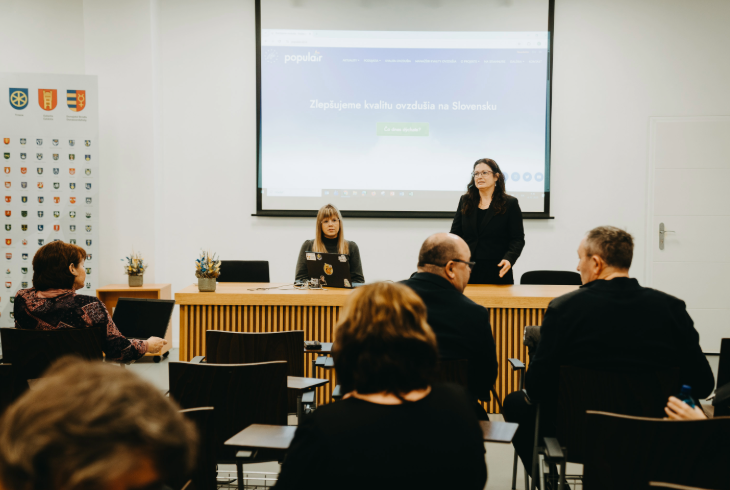
An introductory meeting on the update of the Air Quality Improvement Program (AQIP) for the Trnava Region zone was held at the Trnava Self-Governing Region Office on December 4, 2025. The event was organized by the Trnava District Office in cooperation with the Ministry of the Environment of the Slovak Republic and the Trnava Self-Governing Region (TTSG) as part of the activities of the LIFE IP project – Air Quality Improvement (Populair). The currently valid program was issued by the Trnava District Office in 2013, therefore its update is one of the key tasks of the upcoming period.
The Trnava District Office is obliged to prepare an AQIP for the Trnava Region zone under Act No. 146/2023 Coll. on Air Protection in a situation where air pollution exceeds the limit or target value. Despite the fact that there have been no exceedances in this zone in recent years, the air protection authorities have started to create a program due to the announced tightening of limits and due to the interest in improving air quality.
The Slovak Hydrometeorological Institute (SHMI) annually compiles a list of so-called risk municipalities threatened by deteriorated air quality. In the Trnava Region, 17 risk municipalities were identified for 2025 based on an integrated assessment. These are the municipalities of Blahová, Borský Mikuláš, Dechtice, Drahovce, Jalšové, Jelka, Koplotovce, Okoč, Podbranč, Prašník, Ratnovce, Sasinkovo, Sokolovce, Šaštín-Stráže, Šoporňa, Veľký Meder and Zlaté Klasy. Other municipalities and cities were also invited to the meeting, including Senica, Sereda, Topoľníky and Trnava, as they play a significant role in monitoring and managing air quality in the region. The mentioned locations are part of the National Air Quality Monitoring Network and continuous monitoring is carried out there.
The aim of the event was to create a unified platform for the exchange of experiences, setting common priorities and coordination in the creation of effective measures to improve air quality, especially in the context of new European limits for pollutants under Directive (EU) 2024/2881, which aim to protect public health based on scientific knowledge and recommendations.
TTSK provided premises, technical support and organizational support for the meeting, thereby contributing to the connection of the state, regional and local levels of air quality management.
Air quality: problems and new challenges
In the introductory presentation of the Populair project, the participants were introduced to two fundamental problems that affect air quality in the Trnava region:
household heating – especially the use of unsuitable fuel, old boilers, incorrect heating methods and insufficient renovation of buildings,
car transport – a high number of passenger cars (2.7 million in Slovakia), the high age of the vehicle fleet (on average 15 years), which is responsible for increased emissions of solid and gaseous pollutants
Impact on health: shortening of life expectancy
The Institute of Environmental Policy presented the results of the analysis Exposure to air pollution and loss of life expectancy in Slovakia, especially for the Trnava region. The analysis shows that fine dust particles PM2.5 and benzo(a)pyrene have the greatest impact on health. Therefore, without intervention in household heating, it will not be possible to achieve a fundamental improvement in the health of the population.
Participation of municipalities: why municipalities are a key partner
Municipalities play a key role in the process of preparing and implementing the AQIP, because they know local problems best, can propose and implement effective measures and, as actors in direct contact with local residents, can effectively communicate and explain the need for changes. At the same time, they have expert analyses from the SHMI and methodological and professional support in the form of air quality managers from the Populair project. Municipalities have a unique opportunity to fully use the available tools until the project duration (31.12.2027) – from education and awareness-raising opportunities to field advice or demonstration activities, which can significantly help them in preparing and implementing their own solutions to improve air quality.
Discussion on measures
Mayors discussed measures implemented since 2013, which were supposed to contribute to improving air quality. These included replacing heating equipment, reducing the energy consumption of buildings, modernizing vehicle fleets, planting greenery, and various educational activities. The next meeting of the working group will take place in February 2026. The subject will be an overview of implemented projects and activities that will form the basis for the proposal of new AQIP measures.
Cooperation as the key to cleaner air
The meeting confirmed that effective air quality management requires the connection of high-quality data, local experiences, and coordinated action by the state, region, and municipalities. According to experts, the Trnava region has the potential to become a model for other regions of Slovakia, precisely because local governments, state administration, and professional institutions are starting to jointly plan solutions that can bring a visible improvement in the quality of life of residents.